
Introducing Eileen G'Sell
CHMSN member Eileen G'Sell answers our questions in advance of her forthcoming book Lipstick (Bloomsbury, 2026)


What initially drew you to join the Cosmetic History and Makeup Studies Network?
I was delighted to discover the CHMS Network through my Lipstick research in 2024, as I was developing the organization of my forthcoming book. Hillary Belzer and Lucy Jane Santos had both published on the (negligible!) role of lipstick in the Women’s Suffrage Movement in the United States, and I reached out to both of them in gratitude for their insights. Like a lot of people, I’d the mistaken idea that red lipstick was worn in some kind of rebellious fashion by first-wave feminists. It’s a pretty, and pretty provocative, picture: women in white dresses and white parasols storming Fifth Avenue on a spring day, their chanting mouths an urgent red. But, as I argue in Lipstick, it’s almost certainly a total lie—and not entirely a white one!
Can you share a bit about your background and what sparked your interest in cosmetic history and makeup studies?
As a young girl growing up in the American Midwest in the 1980s, I was a total contradiction: I was a consummate tomboy who loved to fish and catch frogs, but I also adored makeup and beauty culture of any kind. Around seven or eight years of age, I whipped up perfumes and other concoctions in the basement (all lemon-scented!) and tried to sell them door-to-door (without much success).
Recently, I found a journal entry for a middle-school class in which I write that, for my future career, I aspired to be “a Broadway star, a cosmetic chemist, and a neonatologist.” So, from a very early age, I’ve been intrigued by cosmetic culture, and wanted to be part of it in some way. Though for the past two decades, I’ve devoted my life to poetry and cultural criticism, beauty culture has often played a part in that. With Lipstick, I threw myself headlong into makeup studies for the first time, and learned so much about the beauty industry that intersects with my enduring intellectual investment in questions of gender, race, and economic class.
Are there specific projects or research areas within the discipline that you find particularly fascinating or that you’ve been actively involved in?
The overlap in lipstick stigma (and makeup stigma in general) with sex work stigma proves especially fascinating to me. Of course, I’d grown up hearing women called “cheap” for wearing bright makeup, but I didn’t really understand what that meant, or how it tied to assumptions about class precarity, or—historically, at least—the potential to be construed as a sex worker. All of my research suggests that, the more economic solvency a woman has, the less stigmatized she will be for choosing to paint her face. But if one economically struggles, the opposite tends to be true. I still see signs of this today in terms of how we interpret colorful faces in popular culture.
Are there any significant historical developments or cultural shifts related to cosmetics that you believe have been overlooked and deserve more attention?
So many! As an art and film scholar and critic, I’m especially interested in how lipstick’s destigmatization can be traced to late-19th and early-20th century visual culture. Victorian print advertisers smudged the line between the image of the sex worker and “respectable” woman to encourage potential female consumers to see themselves as connoisseurs of pleasure. A lot of the women featured in these colorful ads seemed to be wearing some sort of lip paint. But it wasn’t always crystal clear whether this lusty woman was selling sex, or something else. The ambiguity here wasn’t just meant to titillate men, but also to spark new desires among millions of women—encouraging them both to indulge in certain products (and pleasures) once thought improper and, crucially, to see themselves as objects of visual consumption for others. Sex sells—and, as advertisers quickly discovered, not just to randy Victorian lads.
Another big reason that lipstick dropped some of its baggage was the explosion of motion pictures. As women, immigrants, and the working poor filled theatre seats, American studios churned out fanzines that exhorted readers across social classes to identify with their favorite screen stars. While good girls like Lillian Gish whimpered around in softer hues, the bold-lipsticked “vamp” emerged as a Hollywood archetype in the form of Theda Bara, whose lead turn in Cleopatra (1917) screamed cringey exoticism before Elizabeth Taylor was even born. Before they began incorporating photographs, movie mags like Motion Picture Magazine and Photoplay featured detailed, full-color renderings of celebrities from famous illustrators. Once again, the hand-tinted nature of these images meant that one couldn’t necessarily tell if the star was wearing lipstick or just inherited an enviably vibrant smile.
In 1910, Max Factor Sr. invented the first foundation specifically for film actors (“Supreme Greasepaint”!). By the 1920s, Factor was Hollywood’s biggest makeup artist, marketing his $50 “makeup kits” to women who mostly couldn’t afford them. His fifty-cent lipstick—about $9 today—proved an affordable luxury by comparison. Even more crucial to boosting makeup’s rep, he shilled specific techniques that could enable the average woman to remake her face for the better. “What Max Factor has done for the Stars, he can do for you,” reads a print ad from 1928.

Max Factor ad, 1928
Could you share a memorable experience or discovery you’ve had that has had a lasting impact on your research or perspective?
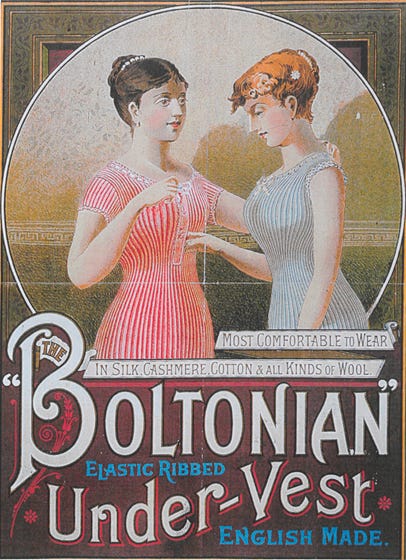
I can think of two specific findings that really shifted my perspective. One was a color advertisement in 1888 for “The Boltonian Under-Vest,” a British girdle-like undergarment. The two young women illustrated feature unnaturally red lips. They also—naughty lasses!—are touching each other in a way that is more than a touch erotic. Seeing something like that sparked my imagination for what it might have been like to see such an image at the time. Lipstick somehow seems proper (connected to wearing a girdle or sorts), but is also sexual in a way that feels more queer than connected to hetero desire. Given that, most of the twentieth century, lipstick has often been viewed as specifically for the “male gaze,” so to speak, this image really struck me.
Another discovery I made had to do with the economic conditions of women during my own lifetime. It’s easy to discount the 1980s as the heyday of backlash conservativism, and in a lot of ways it was. But women in the United States dramatically narrowed the gender gap in income during that decade. The jump in annual wages from 60% of men’s to 71.6% happened in just ten years—and since then the growth has been very sluggish. If women can be financially solvent without a male partner, and keep wearing makeup, it somewhat challenges the twentieth-century notion that cosmetics are primarily worn to “even the playing field,” beauty-wise, when it comes to securing a mate.
And finally, can you tell us a little bit about your current research project?
Now that Lipstick is out, or soon to be, I’m thinking about conducting more research on the concept of “glamour” as a social and aesthetic value (or threat!). Glamour is a relatively recent idea, especially as it relates to beauty history. Many conflate glamour with affluence, but I think it’s more complicated. Many of the most glamorous people I’ve met are not wealthy, and many of our most glamorous celebrities did not come from wealth. Glamour is, in a way, more interesting than beauty to me because it isn’t as tied to genetic inheritance. And glamour endures where youthful beauty fades. As I age, I do not believe I will always be beautiful. But I hope I will always be glamorous!
Huge thanks to Eileen for answering our questions. You can read more about her work on https://www.eileengsell.com/ and don’t forget to pre-order her book.
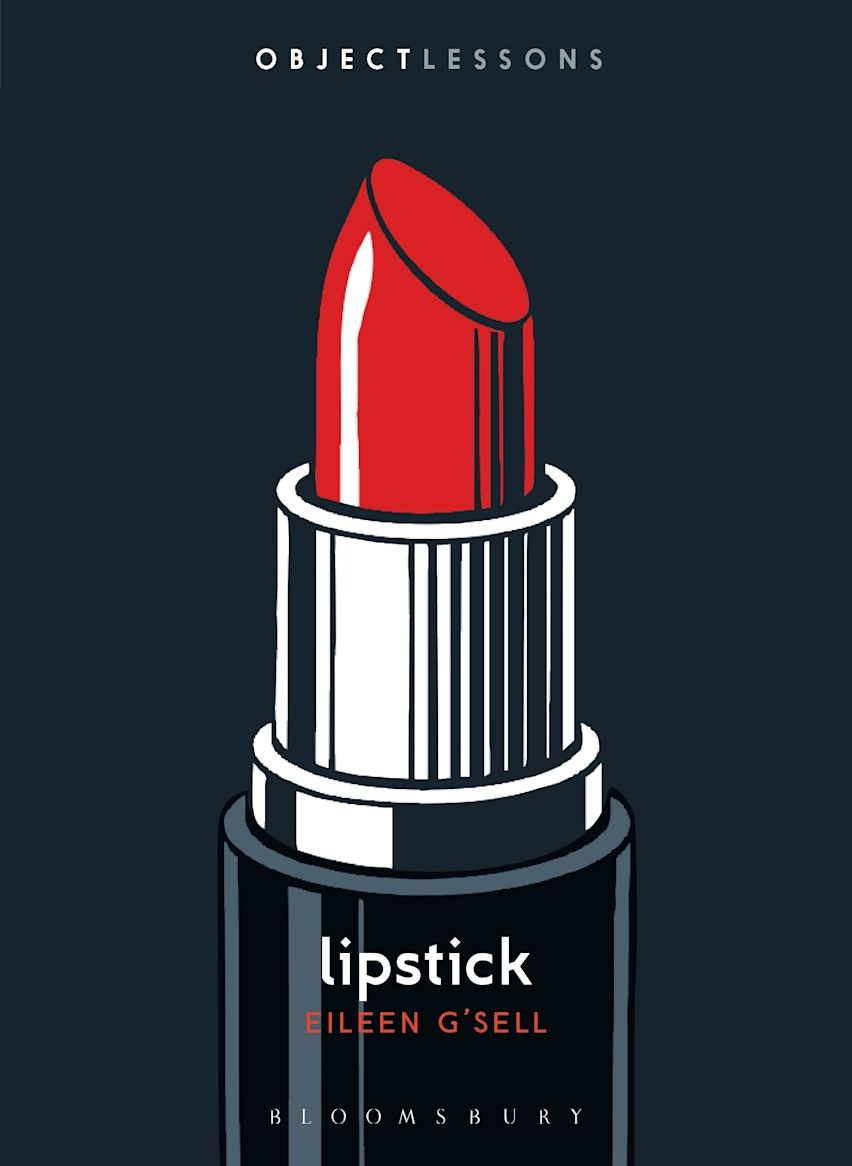
Object Lessons is a series of short, beautifully designed books about the hidden lives of ordinary things.
From Revlon to Glossier, from Marilyn to Gaga, lipstick is as shape-shifting and unwieldy as femininity itself.
Who wears lipstick today – as a matter of routine? And for those who do, is it out of obligation to a strict feminine standard, or some other reason entirely? Lipstick reconsiders the beauty world's most conspicuous – and contentious – tool of artifice. Tossing expired ideas about femininity like so many tubes of melting wax, Lipstick explores how self-adornment can be a source of play, pleasure, and transformation, as well as how lipstick can knock gender norms off balance.
Pre-order (UK) https://www.bloomsbury.com/uk/lipstick-9798765135587/
Pre-order (USA) https://www.bloomsbury.com/us/lipstick-9798765135587/